
***UPDATED***
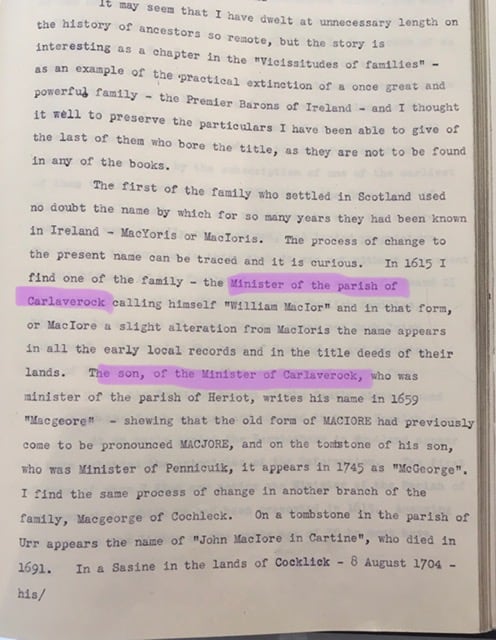
Margaret Ellerby (née Macgeorge) sent us a photo of a family history book written over 100 years ago.
“I wondered if there was any information about William McIor, the minister of Caerlaverock in 1615!
I live in London and currently having a look around the area for traces of McGeorges and Macgeorges (we don’t know when the spelling changed).”
Can anyone shed some light on the Macgeorge/ McGeorge/ M
You can comment below this website post, on our Facebook page or send us an email/ message and we can pass all info on for you.
Email:
caerlaverockcommunity@gmail.com
***UPDATE***
Neale Lawson has kindly sent us some information, which we are passing on to Margaret, and you may find interesting yourself:
“I have come across an article on William McGeorge, Minister of Caerlaverock in 1615. I
have done some research on him in connection with John Hutton.
William McGeorge was “presented” to the parish by James VII in 1615 and
unlike most ministers he was not ejected at the Restoration in 1660 when
most of the Ministers were replaced by Episcopalians. Although I
haven’t found it in print I believe the reason was probably because he
had been appointed by the King so he could hardly be replaced when
Charles II was replacing ministers who had not been appointed by a King
during the Commonwealth. William was allowed to continue as Minister of
Caerlaverock but like others in his position he was “confined to the
parish” meaning he could not administer outside Caerlaverock. He died in
1669 and an Episcopalian Minister was appointed but he only lasted 6
months until another John Burnie became Minister in 1771. John Burnie
is supposed to have had John Hutton as his herdsboy but there are
problems with this supposition, written in the Statistical Account of
the 1790s. As John Hutton died in 1712 the information would have been
second or third hand and I think is perhaps incorrect.
The first written mention of John Hutton is in the Edinburgh University
Class List of 1792 in which John was placed in a class only requiring a
two year course to get his degree as he had already had sufficient
education to exempt him the first two years. John Burnie came to the
parish in March 1771 and John Hutton was on the Class List of February
1772 This hardly gives time for John Burnie to have got to know him
well enough to realise his potential, arranged for his education and to
give him sufficient learning to have been given two years exemption.
John Burnie was also well off and could easily have afforded to pay full
wages for an agricultural labourer.
William McGeorge must have been an old man in the 1660s as he had come
to the parish in 1615 as the Minister. I believe John Hutton and his
sister Grizzel were probably orphaned. John would have attended the
school at Chapel Hill but he would not have learned Latin required for
University. John Hutton’s birth date is not known but going to
University ion 1772 would make him at least 12 and the fact he had
already had some education I suspect he would have been about 15 and so
he is most likely to have been William McGeorge’s herdsboy in the 1660s.
William McGeorge’s son was a schoolmaster in Dumfries, married the
daughter of one of the town burgesses and later became a Minister so
there is every chance this is how John got his education. There is a
possibility that John Burnie who with his wife was known for his good
deeds, might have paid for John at Edinburgh and later Padua
Universities but I have a little difficulty with this. John was a very
staunch Presbyterian, he had to escape Scotland because he would not
sign the Test Act and was not invited with other members of the new
Royal College of Physicians, of which he was secretary, when three of
the founder members were knighted by the Duke of York (later James VII)
because of his Presbyterian sympathies.
There is another possibility as John is supposed to have become
friendly with a “gentleman’s ” son and perhaps the gentleman saw some
benefit in John accompanying his son to University. Perhaps one day
some private family papers may answer this question? No other obvious
name stands out in the Class List of a student who might have come from
a Dumfriesshire family.”
Did he die around 1679, do you know? Or would that be the son?
I read the extract from the Scottish nation: or The Surnames, Families, Literature, Honours and Biographical History, Volume 2, by William Anderson 1862.
http://www.kirkcudbright.co/historyarticle.asp?ID=216&p=…
And here is what it says:
“Macgeorge, originally Mac Jore, the surname of an old family which, from an early period, was settled in Galloway. Towards the middle of the 17th century they had become divided into several branches – all landed proprietors and all in the same district, chiefly in the parish of Urr.
One of these branches was Macgeorge of Cocklick, another Macgeorge of Culloch, and a third became proprietors afterwards of the lands of Auchenreoch and others. The name, at an early period spelt and pronounced Macjore, appears in that form on the tombstone of one of the families in the churchyard of Urr so late us the end of the 17th century. The inscription on this tombstone is interesting as showing the change in the writing of the name in the same family. It is as follows – “John Macjore in Cartine died 28 Feb. 1691, aged 80: also John M’George of Cocklick his son. He died 17th June 1726 aged 69.” There were two other branches, believed to be of the same family, in the county of Ayr – which was originally a part of Galloway. These branches originally spelt the name Macjarrow, and it so appears in the statute of 1 William and Mary, restoring the “memory, fame, and worldly honours” of above 400 of the victims of oppression during the twenty-three preceding years. In this roll the names are entered as Macjarrow of Perjarrow and Macjarrow of Altaberry.”
Here is what I don’t understand! At one point they mention that the surname was originally spelled as Macjarrow , and at another point they mention Macjore. What’s the difference? Where do each of them stand? I’m confused.
“By the beginning of the 18th century the names of all these families had come to be spelt and pronounced Macgeorge. They appear to have been of Irish extraction. There were branches of several distinguished Irish families settled in Galloway, such as the clan Carthy (called in that district Macartney), and others; and the late Mr. Brydson, the author of an excellent work on Heraldry, is of opinion that the family of Macgeorge is descended from the ancient Irish clan Mac Yoris, which had settled, he says, at an early period, in Galloway, and which, in the time of Henry II., was reckoned among the great families of Ireland. This is confirmed by the manner in which the name at an early period was pronounced and spelt in Galloway.”
Someone told me that Mac Yoris is in fact the MacFheorais family (that were descended from the De Birmingham family). Is that the one?
Based on what is the connection made to the MacYoris/MacFheorais family?
I really hope someone could answer my questions and shed some light on the topic, as I’m confused.
Also, I’d love to hear your views on the authenticity and accuracy of that information.