

Thank you to Claire Clarke who shared with us this information from Butterfly Conservation article about the urgent conservation work needed to protect the rare small blue butterfly’s remaining colonies and create the right conditions to allow the butterfly to spread back into its former territory in Scotland.
During Small Blue Week, organised by Butterfly Conservation Scotland, which will run from 1 to 10 June – volunteers are being asked to visit known Small Blue sites to help look for the butterfly and its food plant, the kidney vetch. Surveys will also take place to identify any potential new breeding sites for the butterfly. It would be brilliant if there were any sightings/ potential new breeding sites in Caerlaverock, or Dumfries and Galloway as a whole!
Have you seen a small blue in Caerlaverock? Do you know of any kidney vetch locally?
Kidney Vetch
This is the best site we found for information and identification of kidney vetch: www.virtualheb.co.uk/kidney-vetch
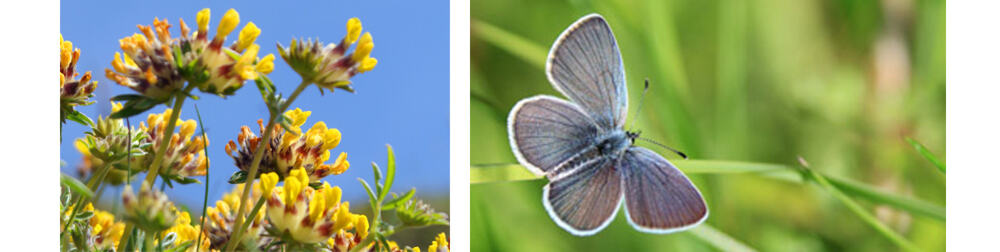
Credit virtualheb.co.uk and Rob Solomon
The yellow flowers of Kidney Vetch [Anthyllis vulneraria] show their heads in May through to September. Their rounded heads of yellow-orange flowers, can occasionally be pink, white and red.
They are frequently seen near to the coast, liking dunes or sandy soils. It can be found in scattered places around the whole of Scotland, so lets get looking!
Small Blue Butterfly Identification
With a wing span range of 20-30mm, the UK’s smallest resident butterfly is easily overlooked, partly because of its size and dusky colouring, but partly because it is often confined to small patches of sheltered grassland where its sole foodplant, Kidney Vetch, is found.
The Butterfly Conservation article explains that, the ‘Small Blue is much darker in appearance than Scotland’s most widespread blue butterfly, the Common Blue. The upper wings of the Small Blue are almost black with a very light dusting of blue scales and the butterfly can be seen flying from mid-May to late June.’ So keep your eyes peeled!
This page has some excellent information and identification help.

Image credit Jim Asher and Peter Eeles
Paul Kirkland informed us, via Facebook that, ‘Sadly it is believed to be extinct in D&G, the last record being made at Rockcliffe in 1980. However it is elusive (and tiny) so could still be present where its foodplant, kidney vetch grows.’ We live in hope!
For more information on how to help the Small Blue butterfly, email Scotland@butterflyconservation.org or visit www.butterfly-conservation.org/scotland
…and do keep us posted of any sightings too!
caerlaverockcommunity@gmail.com or through our Facebook Page