
Author: Johnny Scott
Republished from The Field, November 9, 2010.
The River Nith, the seventh-longest in Scotland, starts life in the Carsphairn Hills of East Ayrshire, flowing through Nithsdale in Dumfries and Galloway until it spills into the Solway Firth south of the village of Glencaple in the parish of Caerlaverock. This is an enchanting area of broad horizons and spectacular natural beauty dominated by birdsong. The vast expanse of mudflat and saltmarsh is a historic feeding ground for millions of waders and a winter haven for a great multitude of migratory duck and geese, their movements controlled by the endless ebb and flow of the tides.
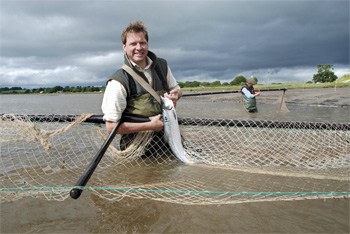
The River Nith’s estuary is a dangerous place of shifting channels, quicksands, soft mud, rip tides and volatile weather. A neap tide rises 11ft and a spring one, which covers the surrounding marshes and travels at 15 knots, as much as 23ft. It is one of the two rivers in Scotland, the other being the Annan, where the ancient art of haaf-netting is still practised by a dwindling band of aficionados. Haaf-netting is of Viking origin and has been described as living archeology; "haaf" is old Norse for sea or channel. A haaf net consists of a "poke" net mounted on a rectangular frame about 6yd long by 11⁄2yd high, made of a shaved cedarwood beam supported by three ashwood rungs, the central one extending above the top beam by about 18in. Fishermen wade into the shallow waters of the estuary carrying the "haaf back," as it is known, over their shoulder and face the incoming flood or outgoing ebb tide. It is a very social form of fishing with two, three, four or perhaps five netters forming a line and changing position as the tide rises. The frame is held upright by the central rung in one hand, while a few strings of the net, which billows round the netter like an enormous bra, are held loosely in the fingers of the other. Into these enticing cups, the haaf-netters hope, a salmon, sea-trout, mullet or even large flounder may chance to swim. The largest haaf-netting station on the Nith is owned by the Caerlaverock estate, which holds about four miles of riparian and baronial fishing rights on the east bank.
Traditionally, permission to haaf-net was given to the estate workers and those living in the villages of Glencaple, Bankend and Sherington, which form the parish. The skill of handling a haaf net was passed from generation to generation, and part of the catch always given to the laird and minister of the kirk; anything else was a dietary bonus for the fishermen’s families. With the decline of salmon stocks, haaf-netting came under a cloud; rod fishermen believed fish that would otherwise have made it upriver were being trapped by the netters. To dispel this myth and give people the opportunity to experience a unique fishing method, the estate has, for the past few years, donated a day’s haaf-netting tuition with the estate keeper to the Heather Trust’s annual sporting auction. This year’s successful bidder was Henry Clarke, a keen sportsman, who has flogged the waters of many a northern salmon river as well as trying his luck in places such as Idaho and Georgia. Although the season runs from 25 February to 9 September, few haaf-netters venture into the water until May and salmon do not run in any numbers much before the beginning of August. The first convenient date coinciding with a favourable tide was 26 July and that morning Henry and his wife Virginia were met on the quay at Glencaple by Robbie Cowan, the Caerlaverock keeper, and Tom Brown, treasurer of the Nith Haaf Netters Association (NHNA) and chairman of the Caerlaverock Wildfowlers. I joined them with Ronnie Clark, NHNA chairman, Wally Wright, who was the warden of the National Nature Reserve for 27 years, and Jim Henderson, fishery director of the Nith District Salmon Fishery Board, which manages the river. While we clambered into chest waders, Jim described some of the conservation work of the Board and its excellent re-lationship with the NHNA. There are around 65 haaf-netting permits issued on the river, of which 30 are allotted by the Caerlaverock estate. Robbie represents the haaf-netters on the Salmon Fishery Board and every year the haaf-netters contribute to the Board’s restocking programme which introduces approximately 750,000 migratory fish fry into the river and its feeder streams annually. There is no haaf-netting on weekends during the season; any salmon caught before the end of April and all sea-trout over 3lb are returned; fishing between low water and the tide run is not permitted and the Haaf Netters Association has voluntarily banned the use of multi-monofilament nets. String is more in keeping with tradition – the original nets were made of flax or nettle fibre – and is kinder to fish re-turned under conservation policies adopted by the netters.
The central channel of the Nith was still surrounded by a broad expanse of mud and sand, but the tide was due to run at 11 o’clock and farther downriver, where the estuary broadens, five haaf-netters were forming a line. There had been rain earlier and the forecast was for a dry day, pro-pitious fishing conditions, according to Wally. "If rain comes with the tide, you may as well bide," he told us. "If it comes with the ebb, you may go to your bed." In other words, fish will stay upriver if they sense floodwater. In a remarkably short time the mud disappeared and Tom, Henry and I waded in, our haaf backs on our shoulders, at a point just up from the Nith Inshore Rescue Boat station. Robbie positioned himself behind Henry to help demonstrate the technique of heaving the haaf net out of the water in the event of a catch. Considerable skill and synchron-isation is required in manoeuvring a 18ft net against the running tide. As soon as a netter feels the net jerk in his left hand, he takes a step back, the legs of the frame are allowed to float to the surface and the whole thing is heaved upright by the central pillar, trapping the fish. This is disabled by a blow from a wooden club called a mell, hanging from a rope round the fisherman’s waist, and transferred to a fishing bag. This sounds easy. In practice, as I know from experience, it is anything but. The bed of the river is not exactly smooth and the backward step, with water up to your armpits and the weight of the tide against you, can easily turn into a total immersion. Equally embarrassing is the net pivoting at the critical moment and the catch wriggling free.
Haaf-netting requires a strong back and lightning-quick reactions but Henry grasped the principles quickly and after a number of successful practice runs, we settled down for the morning’s fishing, changing position as the tide continued to rise. Haaf-netting in a group is an extremely convivial way of passing time, with the added spice that any moment one might feel a tug on the net. Many of the netters wildfowl through the winter and several, including Robbie, are crew members of the Nith Inshore Rescue Boat Service which assists the police in search and rescue work along the river and coastline. Experienced netters can see fish swimming towards them and one of the tricks is to engage your immediate neighbour in some juicy piece of gossip while casually moving the net back slightly. This creates a slipstream, which deflects a fish away from his net into yours. By slack water there had been no catch and we waded out to have lunch in the Nith Hotel. The Nith is a famous wildfowlers’ pub and in the days when there were more men on the farms and more salmon in the river, it was the venue for the annual haaf-netters’ ball. We returned to fish the ebb tide but as the afternoon wore on, the day looked to be a blank and none of the other netters appeared to be having any luck. The Clarkes were under pressure to leave for their flight from Glasgow and Henry had just observed that, what with the misconceptions about haaf-netting, it was probably just as well that we hadn’t caught anything, when he let out a yell, stepped back and heaved his haaf back out of the water.
Tangled in the net was a superb 6lb grilse. Determined to catch another, Henry was soon back in the water with Virginia waving urgently from the bank. He was finally persuaded to leave and they took off in the direction of Glasgow in a cloud of burning rubber. Approaching the airport, it occurred to Henry that he had forgotten to gut the fish so, spotting a Holiday Inn, he made a rapid detour, swept past reception, grabbed a knife from a cutlery canteen and dived into the Gents. The knife proved to be blunt but, time being of the essence, Henry managed to shovel his way in. He was busy ripping out intestines, with blood, guts and bits of liver splattering everywhere, when the door opened and an elderly Glaswegian wandered in. One does not usually ex-pect to find a man gutting a fish in a hotel lavatory but as he passed Henry, guiltily clutching a knife and dripping in fish effluent, the old boy simply grunted, “nice catch”.