
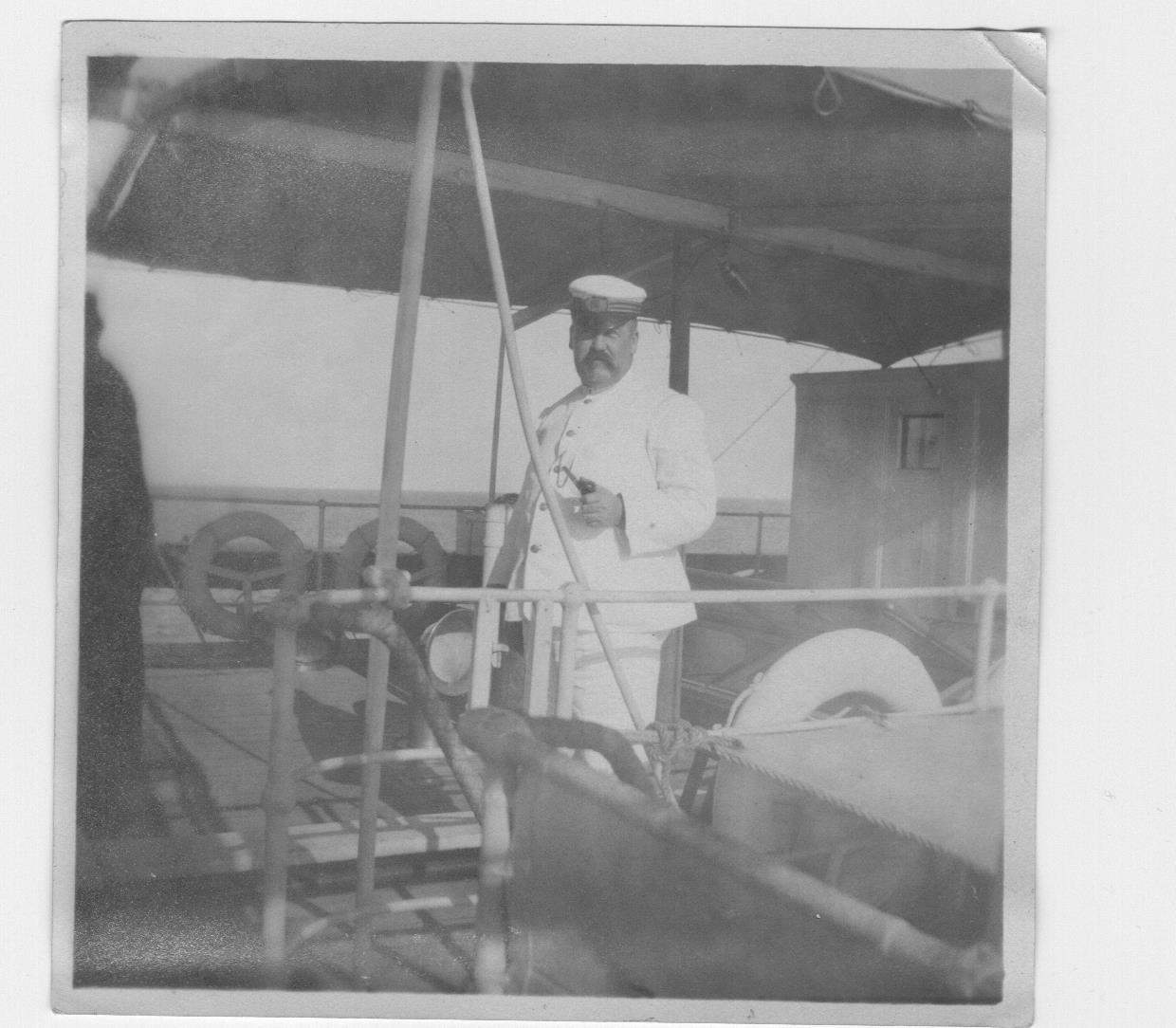
It seemed fitting to publish the report of this heroic rescue on the 100-year anniversary of the event of 5th March 1916.
Following the interest surrounding our recent article from John Roberts about a Glencaple family history, he sent us the following, equally fascinating, account of events:
“Please find attached story and photo of my Grandfather Merchant Navy Captain John Robb (1873-1933) – eldest son of James Robb (1840-1898) school teacher and registrar at Glencaple.
The story relates to Captain John Robb and his crew saving the lives of the Captain and crew of the American sailing schooner Cora A, which was shipwrecked on 5 March, 1916 a hundred years ago for which he was presented with an engraved pair of binoculars from the President of the United States.
I saw an article in an American newspaper, where the author was researching shipwrecks, in particular the Cora A, named after the Scottish shipowner’s daughter Cora, but was uncertain as to the ship and crew’s final fate – I was able to provide the answer.
I thought it would be nice to remember my grandfather’s heroism 100 years on and of particular interest to the Glencaple and Dumfries communities.
Born and married in Glencaple, Capt John Robb and his wife Elizabeth moved to Liverpool where he sailed mainly to the West Indies but returned for holidays to ‘Ettrick’ their country cottage in Glencaple. In turn my wife and family moved from Liverpool to our current residence in Yorkshire but have spent many happy times in Glencaple.
The article chronicles the travels of the Cora A. Van Harpen explains the end of the Cora A. is “sketchy” and provides differing opinions about the schooner’s disappearance. Van Harpen ends the article with, “So the end of the Cora A. is still a mystery and one I will keep on searching for answers to.]” My grandfather Captain John Robb rescued the captain and crew from the Cora A. on March 5, 1916. Here is an extract from the report that was in a Liverpool newspaper at the time (titled “Timely Atlantic Rescue”): “At the Liverpool local marine board office today Commander F.M. Sergeant RD Secretary presented a handsome pair of binocular glasses, which were awarded by the President of the United States (through the marine department of the board of trade) to Captain J Robb, Master of the Leyland Steamer Oxonian of Liverpool, in recognition of his services in rescuing the shipwrecked crew of the American schooner Cora A. in the North Atlantic Ocean on 5 March. It was 11 a.m. on March 5 when 300 miles NE of Bermuda that the Oxonian descried a signal of distress flying from the vessel. Captain Robb at once altered his course and bore down. It had been blowing hard for three days previously and a high sea was running rendering it hazardous to lower a boat. In the circumstances Captain Robb determined on a most daring but successful course of action. He placed the ship to windward of the sinking vessel about 100 yards distant thus sheltering the latter from the wind and sea, pouring plenty of oil on the water, which floated the schooner. By this seamanlike proceeding he was enabled to save the whole of the crew, the Captain and six men, by means of ropes thrown to them, the whole evolution taking only fourteen minutes. This timely rescue was providential for within a few hours it blew a perfect hurricane with high sea and there little doubt the schooner foundered that night.” I have the binoculars in front of me and inscribed on them it says, “From the President of the United States to J. Robb, Master of the British Steamship Oxonian, in recognition of his humane services in effecting the rescue at sea on March 5, 1916 of the master and crew of the American Schooner Cora A.” It was appropriate that my grandfather was a Scotsman rescuing the crew from a ship named after a Scottish lady. To see the full article, visit www.ppulse.com Many thanks again to John Roberts for sending this most interesting and detailed contribution. Please do let us know if you have any stories which may be of interest to the Bankend/ Glencaple/ Kelton and Caerlaverock community via our Facebook page or through email at: caerlaverockcouncil@gmail.com