

Having bumped into Alison Roberston one evening in the week, looking slightly suspicious with buckets and bags heading into Castle Woods, we caught up with her the next morning to find out if she’d caught anything in her moth traps from the night before!
And we werent disappointed!
One of her many finds was this amazing creature. It is a poplar hawk moth! What a magnificent moth! [That’s Alison’s finger it’s sitting on in the picture!]
Alison reassured us that she would be taking all the moths back to the same place she found them, once she had recorded them.
Poplar Hawk Moth – Scientific name: Laothoe populi
Poplar hawk moths are the most common of the hawk moths and they can be seen flying at night between May and early August. They don’t feed, but the caterpillars eat the leaves of poplar, aspen, sallows and willow. They are found all over the UK and are common wherever their foodplant occurs. They have one or two broods a year, which overwinter as pupa, in an earthen cell 2–3 cm below the surface, near their host plant.
It is said to look like a cluster of dead leaves of the main host, the poplar. When disturbed, the moth will suddenly reveal a bright orange-red patch on its hindwing, as a distraction/ to startle predators.
They are a large moth with a wingspan of 6.5 – 9cm! Pretty impressive! The caterpillars are rather special too:
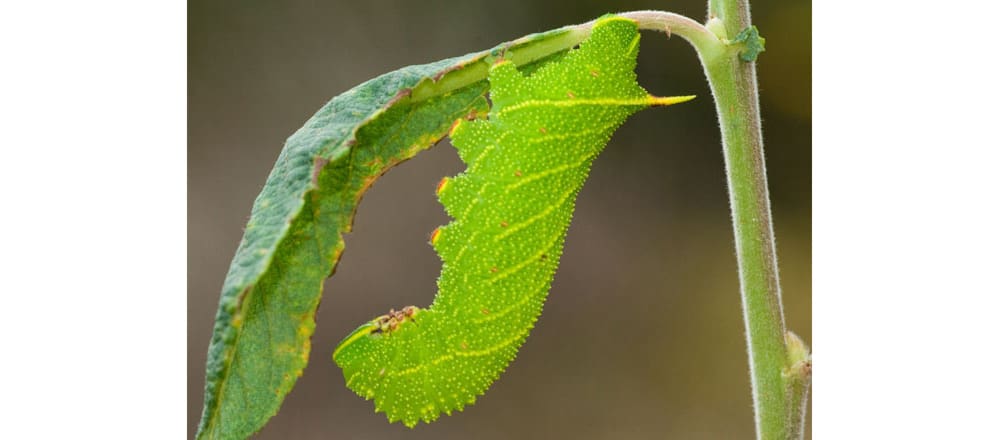
Photo credit: John Bebbington
They are ‘stout bodied’, and grow to 6.5cm – 8.5cm! On first hatching the larva is a pale green with small yellow tubercules (bumpy bits!) and a cream-coloured tail horn. Later, it develops yellow diagonal stripes on its sides, and pink spiracles (holes that delivers oxygen straight to the caterpillar’s tissues). Caterpillars that feed on willows can become quite heavily spotted with red. Others are more bluish white with cream stripes and tubercules.
Here comes your chance to find your own poplar hawk moth, and many other marvellous moths:
Join the NNR reserve staff and local expert Alison Robertson who will show you a wide variety of moths and teach you identification skills and methods to catch your own moths.
15th June 2018
From dusk until late – times will be available at time of booking.
Book in advance on 0300 067 3200
Depart from Castle Corner car park
Bring warm clothing, waterproofs and head torch if you have one.
FREE EVENT